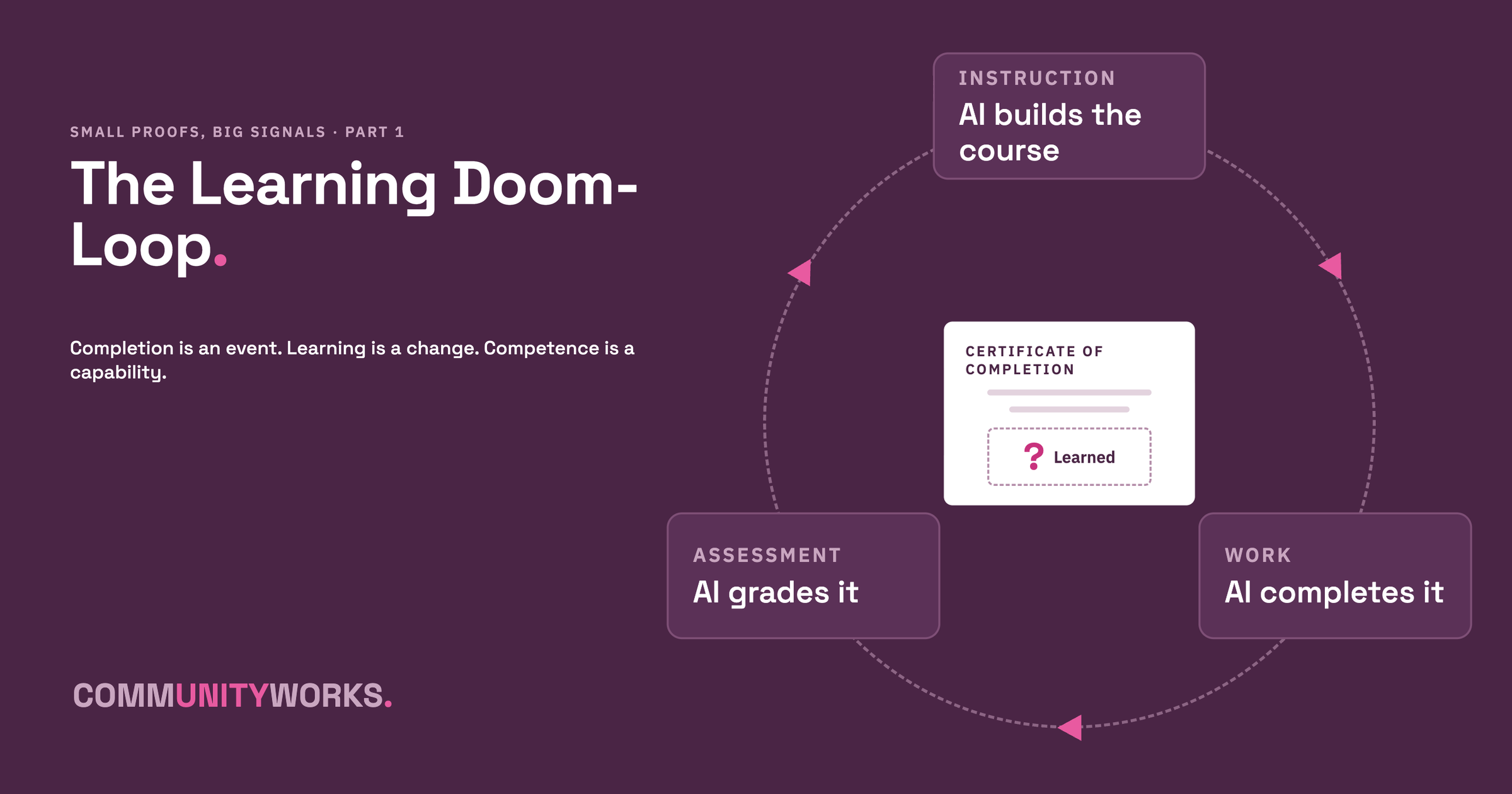
Here’s a loop I can’t stop thinking about.
An instructional designer, short on time and budget, uses AI to build a course. It’s a reasonable choice. The tools are good, the deadline is real, and the content comes out clean and well organized: objectives, readings, a few case studies, a quiz at the end of each module.
A learner, juggling a job and a family, uses AI to complete it. Also a reasonable choice. The assignments look like busywork, the credential is what their employer actually wants, and the AI can produce a thoughtful-sounding reflection in seconds.
Then the institution, facing a backlog of submissions, uses AI to grade it. The rubric is clear, the AI applies it consistently, and feedback goes out faster than any human could manage.
Everyone gets what they need. The designer ships. The learner finishes. The institution issues a certificate.
So did anyone learn anything? Honestly, no one can say.
I call this the learning doom-loop: AI substituting for human effort at every step, from building the instruction to completing the work to assessing it. What makes it unsettling isn’t that anyone did something wrong. Every step is rational on its own. Each person is responding sensibly to the pressures in front of them.
The trouble is what the loop leaves behind. The learner may have learned a great deal. They may have learned nothing. The certificate looks exactly the same either way. The consequence of the doom-loop isn’t that learning stops. It’s the erosion of confidence in the evidence that a learner has learned something.
And it isn’t hypothetical. Every piece of it is happening right now, in college classrooms, in corporate compliance training, in professional development programs. Maybe not all three steps in the same course yet. But we’re close enough that it’s worth asking what happens when we get there.
The proxy
To understand why the doom-loop matters, it helps to remember what a course was ever supposed to prove.
We’ve never been able to see learning directly. We can’t look inside someone’s head and confirm they understand something. So much of modern education relies on proxies for learning: time spent in a course, modules completed, assignments submitted, tests passed. These measures can provide useful evidence, but none of them is the same thing as demonstrating that someone can apply what they’ve learned.
Not every credential works this way. Apprenticeships, oral and practical examinations, professional demonstrations, and competency-based programs all have long histories of asking people to show what they can do. But the course-and-completion model underpins a great deal of modern education, and many of the credentialing systems built around it. We agreed to trust those measures as a good-enough stand-in, because most of the time, a person who did the work and passed the test had probably learned something along the way.
Then we built an enormous amount on top of that proxy. Courses became credentials. Credentials became hiring filters, admissions requirements, promotion criteria, and licensing standards. Entire systems now make decisions about people’s futures based on whether they completed something.
To be clear, the proxy was never great. Students have always copied assignments, crammed for exams, leaned on friends for help, and passed courses they barely remember. Graders have always made mistakes, and course quality has always varied. And effort was never the point. Effort and learning aren’t interchangeable: someone can spend a hundred hours studying inefficiently and learn very little, while someone else learns a great deal in ten hours of focused practice. What the system had working in its favor was something narrower. Producing the evidence usually required doing at least some of the learning. To write the paper, you generally had to wrestle with the ideas. To pass the exam, you generally had to practice the material. The evidence and the capability were loosely tied together, and that tie is what made the evidence worth anything.
The doom-loop cuts that tie. The problem isn’t that AI makes learning easier. That’s a good thing, and nobody should want education to become laborious again. The problem is that AI can make it easy to produce evidence that looks like learning without developing the underlying capability.
What are you actually trusting?
This is where it gets practical, especially for employers.
When a hiring manager sees a certificate on a résumé, they’re making a quiet bet. They’re trusting that the credential means the person can do something, or at least knows something, that they couldn’t before. That bet has always been a little shaky. Some employers rely heavily on degrees and certifications; others weigh experience and demonstrated performance far more. Either way, the credential often opened the door. The real issue isn’t whether someone completed the course. It’s whether the credential justifies the claim that the person can do the job.
Educators face the same problem from the other side. If you can’t trust the work students submit, you can’t trust your own grades. And if you can’t trust your grades, it’s hard to stand behind the credentials your institution issues.
Step back, and the risk is bigger than any one hire or any one grade. A certificate isn’t just a record that someone finished a course. It’s a claim about what that person can do. Depending on the context, that claim might help decide whether someone gets a job, earns a promotion, keeps a professional qualification, or is trusted with real responsibility. Every institution that issues a credential is vouching for that claim.
It helps to be precise about what kind of claim is being made. Completion is an event. Learning is a change. Competence is a capability. They’re related, but none guarantees the next.
Not every course needs to claim a capability. Some are exploratory, some are informational, and some exist to support people’s performance rather than certify it. But when a credential says someone can perform a task on their own, the institution behind it has to be able to justify that claim. The doom-loop makes that much harder to do.
This isn’t an argument against AI
I want to be clear about that. I use AI every day, and I think it can make learning dramatically better.
Imagine two learners in the same course. The first uses AI to explain a difficult concept, challenges its answers, works through examples, and then completes the assessment on their own. The second uses AI to generate the answers, submits them, and passes without developing the capability the course was meant to build.
Both used AI. Only one undermined the purpose of the course. The same is true on the other side of the desk: AI-generated materials aren’t inherently a problem, and AI-assisted grading isn’t inherently invalid.
The question isn’t whether AI was involved. It’s whether the system produces reliable evidence that the learner can do what the credential claims. And right now, those two learners walk away with the same certificate.
If completion can be automated end to end, completion can no longer be what we certify.
That’s an uncomfortable conclusion, because so many of our credentialing systems are built on completion. So what can carry the claim instead?
It’s tempting to answer: build assessments AI can’t pass. But that’s an arms race. As the tools improve, almost any assessment built on producing an answer becomes vulnerable to some degree. And making a test hard for AI doesn’t necessarily make it a good measure of learning.
A more durable goal is evidence that is valid, attributable to the learner, and relevant to the capability being certified. That might look like live demonstrations, follow-up questions, performance in realistic settings, or a body of work that shows growth over time. It might even involve AI, as long as the assessment measures the right capability.
That’s where this series is headed: what that kind of evidence looks like, where it already exists, and why I think the answer has less to do with better tests than with how and where learning happens.
But first, I’m curious: when you look at a credential today, what are you actually trusting? And has that changed in the last two years?