In Part 1, I wrote about the learning doom-loop: AI substituting for human effort at every step, from building the instruction to completing the work to assessing it. The consequence isn’t that learning stops. It’s that we lose confidence in the evidence that learning happened.
One of the most common responses to that problem, in classrooms and in workplace training alike, has been to protect the process that produces our evidence of learning. That takes several forms. AI detectors try to infer whether text was machine-generated. Proctoring software and lockdown browsers monitor or restrict the conditions in which work is produced. Version histories and keystroke logs document how a piece of work came together. And some assessments are redesigned so AI can’t easily stand in for the learner.
These approaches aren’t identical, and they aren’t equally limited. A well-redesigned assessment can sometimes measure capability directly. But many of them share an instinct: protect the integrity of the process, then trust the evidence that comes out of it. That’s understandable, and the people investing in these tools aren’t wrong to worry. For simplicity, I’ll call that instinct detection, and it’s the instinct I want to question. Protecting the process and verifying the capability are different jobs.
Two different questions
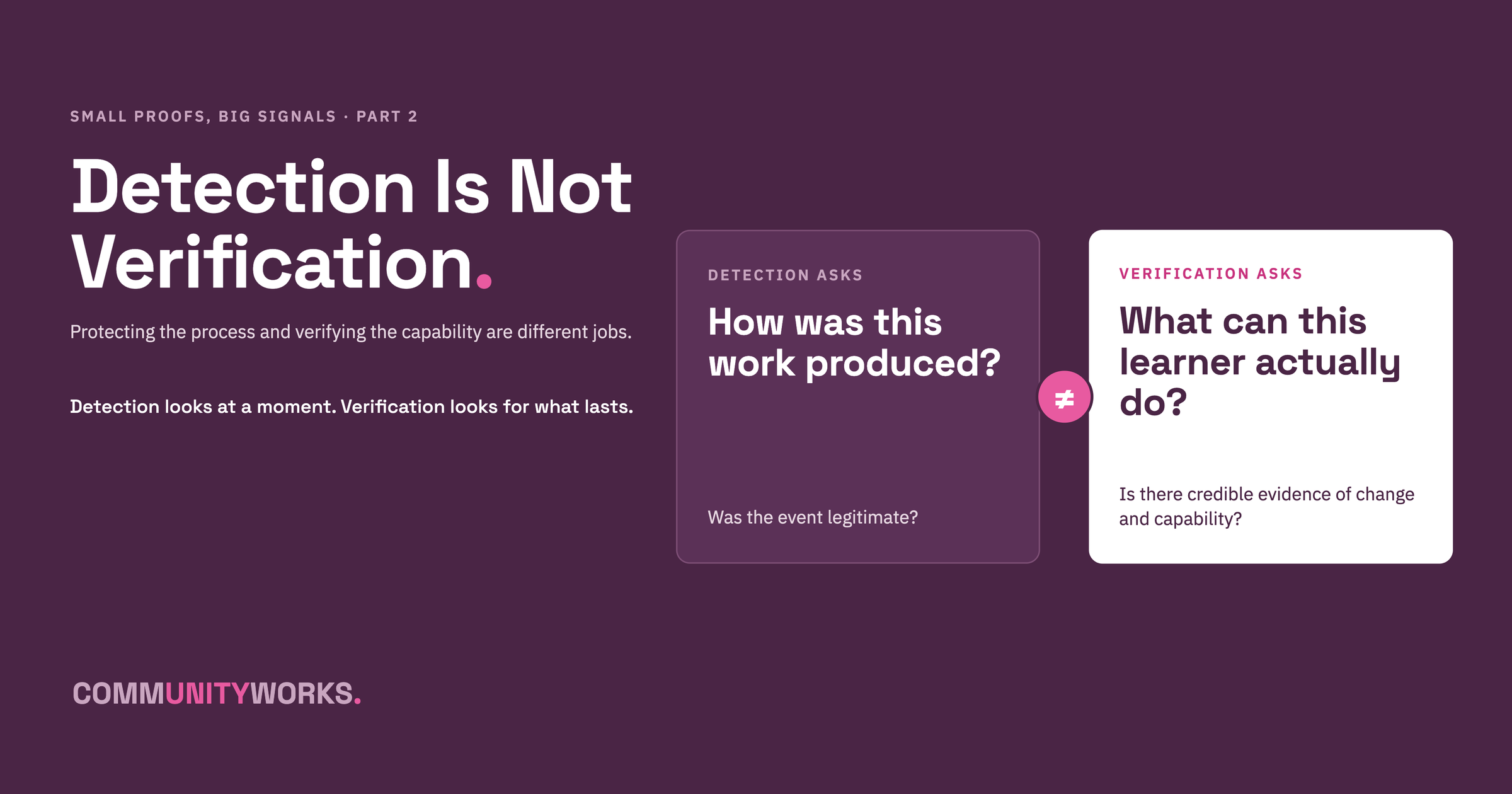
Detection asks: How was this work produced?
Verification asks: What can this learner actually do?
The two are related, and sometimes the first helps with the second. But they aren’t the same question, and a good answer to one doesn’t give you an answer to the other.
Imagine a detector that worked perfectly. It could tell you, with certainty, that an essay was written entirely by the student. That’s useful information. But it still wouldn’t tell you whether the student understood the material, whether they could apply it to a new problem, or whether they’d remember any of it next month. Students wrote their own essays long before AI, and those essays were always imperfect evidence of what they’d learned.
Now flip it. A learner uses AI as a tutor: to explain a concept, to challenge their reasoning, to give feedback on a draft. Some of that AI involvement may show up in the work, and a detector might flag it. But the learner may have developed exactly the capability the course was meant to build.
In the terms from Part 1: completion is an event, learning is a change, and competence is a capability. Detection asks whether the event was legitimate. Verification asks whether there’s credible evidence of the change and the capability.
Bailing the boat
I keep coming back to a boat with a hole in it.
Bailing keeps you afloat. It buys time, and for a while it may even be necessary. But bailing doesn’t fix the hole, and it doesn’t address what caused it.
The hole isn’t AI. AI just made it impossible to ignore. The hole is the assumption that completion is adequate evidence of capability. Completion was always an imperfect proxy for learning, but when producing the evidence usually required doing at least some of the learning, the proxy was easier to trust. Detection tries to make that old evidence trustworthy a little longer.
It’s also a race that gets harder to win. As AI tools improve, the line between human and machine work gets harder to draw. Detection tools make mistakes of their own, too: they produce false positives, and one widely cited study found that the detectors it tested disproportionately flagged writing by non-native English speakers (Liang et al., 2023, Patterns). Every false accusation erodes trust in the other direction, between learners and the institutions assessing them.
Designing assessments mainly so AI can’t complete them is a more sophisticated version of the same move: bailing with better buckets. Being hard for AI doesn’t make an assessment a good measure of learning. When an assessment is both, like a live demonstration, it’s because it measures the capability directly, not because it keeps AI out.
What detection can’t see
After Part 1 went up, Amos Fodchuk, a former teaching colleague of mine, highlighted a useful term from his own reading: the crutch effect. As he describes it, it’s the gap between authentic learning gains and an AI-enabled boost in performance that has little staying power.
Detection can’t see the crutch effect, because the crutch effect isn’t about how a single piece of work was produced. It’s about what remains when the support is removed. A learner can produce entirely human-written work while leaning on support they’ll never be able to drop. Another can use AI heavily and come away more capable.
That’s the heart of the difference. Detection looks at a moment. Verification looks for what lasts.
What verification looks for
If detection isn’t the answer, what is? In Part 1, I suggested the goal is evidence that is valid, attributable to the learner, and relevant to the capability being certified. Some of the ways to gather it:
- Follow-up questions that probe whether someone understands what they produced.
- Transfer: applying the idea to a new problem, without the original scaffolding.
- Demonstration: doing the task live, in a realistic setting.
- Persistence: showing the capability again, later, after the course is over.
- Development over time: a body of work that shows growth, not just a final product.
None of these settles the question on its own. A demonstration can be rehearsed. A follow-up question can test recall instead of understanding. A body of work can be heavily supported by others. The stronger approach is to gather different kinds of evidence that converge on the same conclusion: this person can do what the credential says they can do.
Interestingly, AI may help here too. Amos pointed me to a chapter in the OECD’s Digital Education Outlook 2026 on dialogue-based AI tutors, which question, scaffold, and adapt alongside a learner. Building on that, he suggested that a well-designed tutor could leave behind evidence a finished assignment rarely shows: where a learner struggled, which misconceptions surfaced, how much support they needed, and whether that support could fade.
A record isn’t automatically evidence, of course. A conversation log matters only if it captures real changes in understanding and shows the learner eventually working without support. Amos made the same point himself: “The same technology that weakens our old proxy for learning may help us build a better one.” But probably only, he added, “if we design for demonstrated independence rather than polished performance.”
That’s the shift: from asking whether the work is authentic to asking whether the capability is real.
The next problem
Verification is harder than detection. It takes more time, and it usually involves people: someone asking the follow-up question, watching the demonstration, noticing the growth.
And even verified capability doesn’t stand still. A credential often records a moment, but the work keeps changing. Next week I’ll take on that problem, what Neil Redding calls clock drift.
In the meantime, a question for the employers and educators following along: if you removed every detection tool tomorrow, what evidence of learning would you still trust?