In Part 1, I described the learning doom-loop and a simple framework: completion is an event, learning is a change, and competence is a capability. In Part 2, I argued that detection is not verification. Protecting how work was produced doesn’t tell you what a learner can do, and verification looks for what lasts.
This week I want to add a complication. Even when the evidence behind a credential is good, and the capability it describes was real, time keeps moving.
A borrowed idea
My altMBA cohort-mate Neil Redding has a name for a problem he sees as organizations adopt AI: clock drift. In his words, it’s “the gap between how fast AI-enabled work now moves and how slowly human organizations still decide.”
Neil applies the idea to leadership and decision-making, and he’s put it in front of rooms full of CIOs. I want to borrow it for something narrower: how organizations recognize what people know and can do. I think the drift shows up there too, and it’s easy to miss.
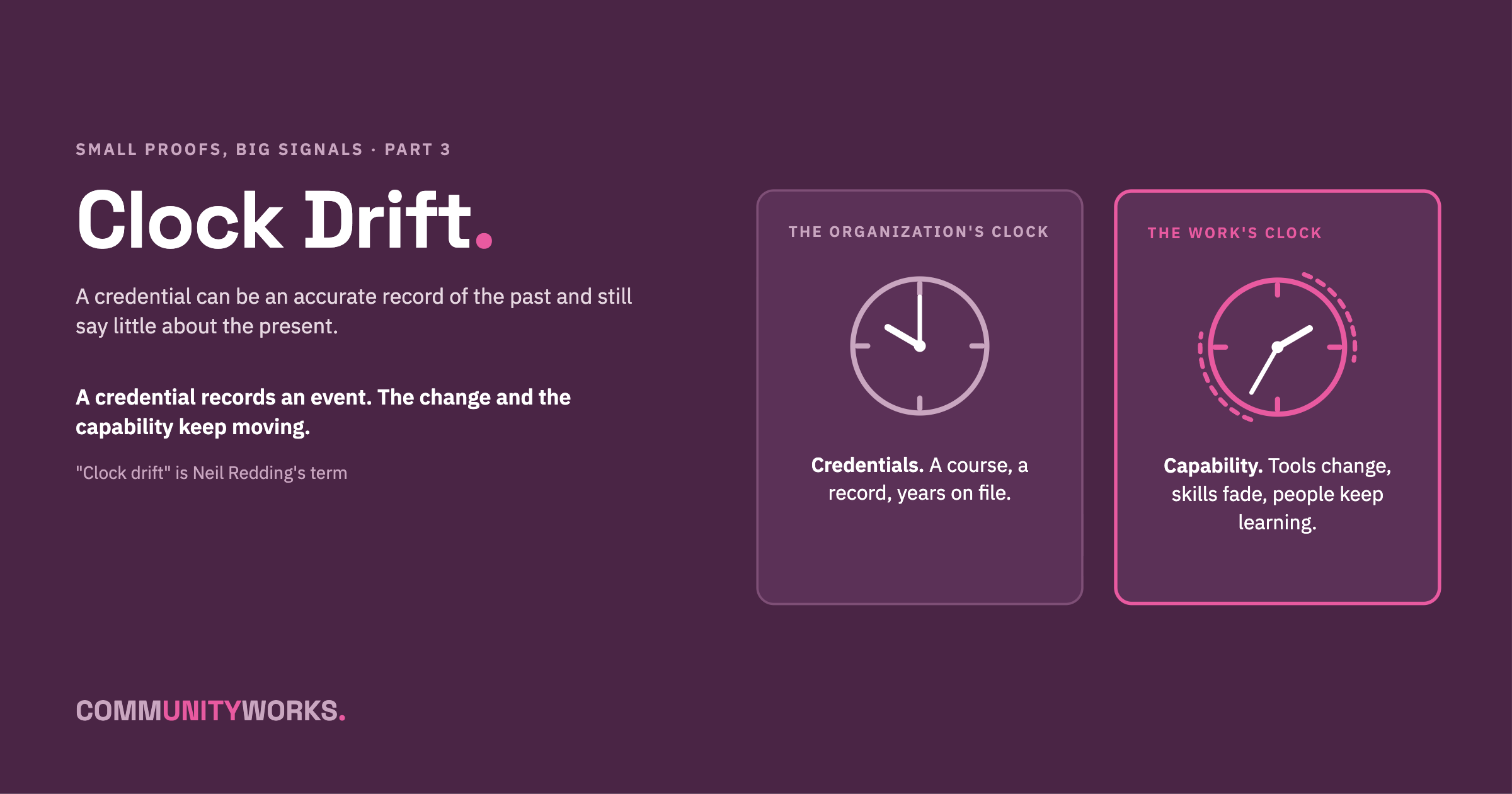
Two clocks
Many credentials run on the organization’s clock. A course is designed, approved and delivered. A learner completes it, and a record is created. That record may sit unchanged in an HR system, on a transcript or on a résumé for years.
Capability runs on the work’s clock. Tools change, processes change, and the skills that matter change with them. Some of what a person was certified to do fades from disuse. Some of it becomes less relevant. And much of what they learn next, on the job and alongside colleagues, never makes it into the record at all.
Put those together and you get drift in both directions. A credential can overstate current capability, describing skills that have faded or gone stale. It can also understate it, missing everything the person has learned since.
Both directions cost something. Overstate capability, and you trust people with work they can no longer do. Understate it, and you overlook the people who actually know how the work is done now, often the very people you’d want training everyone else.
This is also where AI comes back in. In Part 1, the problem was AI substituting for the effort that used to produce our evidence of learning. Here it’s something different: AI is speeding up the work itself. Every time a tool changes how a job gets done, the distance grows between what someone can do today and what their credential says they could do when it was issued.
In the terms from Part 1: a credential usually records an event. The change and the capability keep moving after the record is made.
A familiar example
Imagine a manufacturer that introduces an AI-assisted quality inspection system on one of its lines. Within a few weeks, the operators on that line have figured out how to work with it: when to trust its flags, when to override them, and how to adjust the line when something looks off. They learned it on the floor, from the system and from each other.
Meanwhile, the formal training program is still being scoped. When it finally launches, it teaches the version of the system the operators were using months earlier. Their records still show the certifications they earned before the system arrived. The most current, most valuable capability on that line appears nowhere in the systems that decide who’s qualified, who gets promoted and who trains whom.
That’s clock drift applied to learning. The work moved. The record didn’t.
Doesn’t renewal solve this?
Partly. Many credentials are designed to expire or require renewal: professional licenses, safety certifications, continuing education requirements. That’s an important acknowledgment that capability doesn’t stand still.
But renewal often runs on the same clock as the original credential. Requirements are frequently measured in hours completed or courses attended, which brings us back to the event. And between renewals, the record is still a snapshot. Renewal narrows the gap; it doesn’t close it.
Keeping evidence current
If capability keeps moving, evidence of it has to keep moving too. That suggests a different question for anyone responsible for credentials, whether in a school, a training department or a hiring process. Not just “Is this evidence credible?” but “Is it recent enough to support the claim we’re making today?”
Answering that requires evidence that accumulates over time rather than being captured once. And it points back to the kind of learning that has always kept pace with the work: the learning that happens on the floor, in the field, and between colleagues working through new problems together. It’s fast and current. It’s also mostly invisible to the systems that make decisions.
Next week, I’ll look at where that learning lives, and why it’s so hard to see.
In the meantime, a question for the employers and educators following along: when you look at the credentials your organization relies on today, how old is the evidence holding them up?