So far in this series, I’ve been circling a problem. In Part 1, the learning doom-loop: when AI substitutes for human effort at every step, completion stops telling us much. In Part 2, detection is not verification: protecting the process doesn’t establish what someone can do. In Part 3, clock drift: even good evidence goes stale as the work moves.
This week I want to turn from the problem to the place where I think an alternative already exists.
Ask anyone outside a classroom
Ask people where they learned to do their jobs well, and very few will name a course. They’ll tell you about a supervisor who walked them through their first hard case. A colleague who showed them a better way. A project that went sideways and taught them more than any training did. A group of peers they call when they’re stuck.
Most people who work outside schools and universities already know this. Formal training matters, but much of what makes someone good at their work is learned on the job, alongside other people, while doing the work itself.
That kind of learning tends to have a few things in common:
- It’s tied to real work, so what people learn is what they actually need.
- It’s social. People learn by contributing, asking, getting feedback and watching others.
- It keeps pace with the work, because it happens where the work happens.
- It leaves a trail: drafts, decisions, conversations, and people who saw it happen.
More than attendance
This is where participation becomes something more than showing up. Sitting in a meeting is attendance. Bringing a problem to a group of peers, trying something, reporting back on what happened, and helping the next person who runs into the same problem: that’s participation in the sense that matters.
My former teaching colleague Amos Fodchuk described it well in a comment on Part 2: “Learning, practicing and collaborating in groups … toward authentic outcomes and benefits: that’s the ticket. Multiple drafts, changing perspectives, one form factor that bubbles into another. That beautiful mess showcases the trajectory as much as the output.”
That last line gets at something important. In a course, we usually look at the final product. In a group doing real work, you can see the trajectory: where someone started, what they struggled with, how their thinking changed, and what they can now do that they couldn’t before.
Learning networks and action networks
In my own work, I find it useful to think about two overlapping kinds of groups.
A learning network brings people together to learn from each other: peers in similar roles, often across organizations, comparing notes on shared challenges. Communities of practice are the classic example.
An action network forms to do something together: a working group, a task force, a cross-functional team taking on a specific problem.
The two feed each other. Learning networks surface problems worth solving. Action networks take them on, and what they learn flows back into the larger group.
I’ve watched this play out in a community of practice I help facilitate for senior leaders from different institutions. It started as a place to compare notes. Over time, smaller working groups formed to tackle specific shared problems. The learning didn’t happen in a course. It happened in the work, and the people in the room could see it happening.
The problem: nobody else can
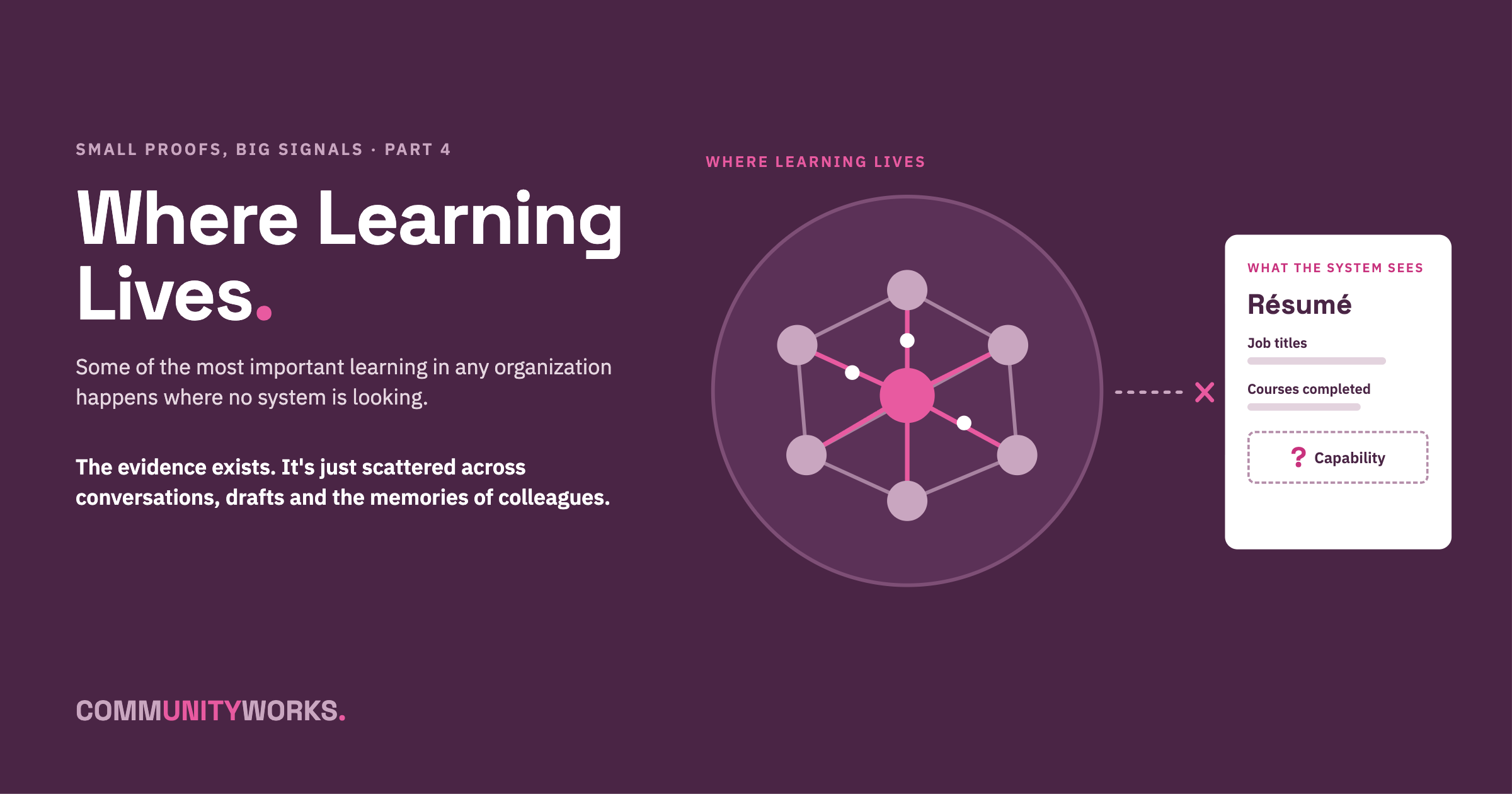
Here’s the catch. All of that learning is real, and much of it is witnessed. But very little of it shows up in the systems that decide who’s qualified, who gets promoted, who gets hired or who trains whom.
The evidence exists, but it’s scattered: in conversations, in shared documents, in project outcomes, in the memory of the colleagues who watched someone grow. Inside the group, people know who can do what. Outside it, that knowledge is invisible.
That invisibility has a cost. Organizations end up retraining people on things they already know, because a résumé lists events, not capability, and there’s no trusted way to tell the difference. They overlook the experts already in the building. And the people doing some of the most valuable learning often have the least to show for it. The networks themselves pay a price, too: when the executives and funders who support them can’t see what people are learning, those networks are hard to justify, sustain or scale.
Next
Next week, I’ll look at how participation deepens over time, from the edge of a community toward its center, through two familiar examples: the internship and the apprenticeship. Then, in a talk at the Roanoke Blacksburg Technology Council’s Emerging Technology Conference on November 19, I’ll take on the question this whole series has been building toward: how learning like this can be recognized in ways other people can trust.
In the meantime, a question for the employers and educators following along: where does the most important learning in your organization actually happen, and who outside that room can see it?